
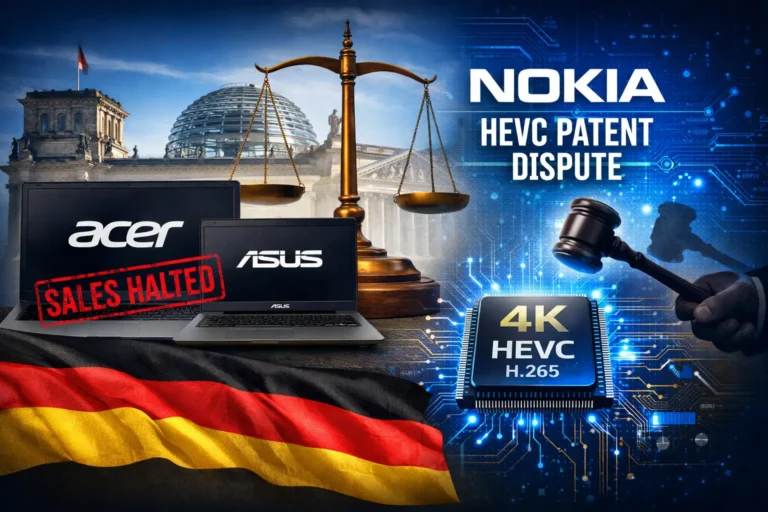

A major legal development in Germany has sent shockwaves through the global PC industry. A German court has ordered Taiwanese technology giants Acer and ASUS to halt direct sales of certain personal computers in the country following a patent dispute victory for Nokia. The ruling centers around High Efficiency Video Coding (HEVC) technology, a widely used video compression standard embedded in modern computing devices.
This decision not only disrupts operations for two of the world’s leading PC manufacturers but also highlights the growing influence of patent enforcement in Europe’s largest economy. Here is a comprehensive look at what happened, why it matters, and what it could mean for the broader technology market.
The Court Ruling Explained
The dispute stems from patents related to HEVC technology, also known as H.265. This video compression standard enables high-quality video streaming and recording while significantly reducing file sizes. HEVC is essential for 4K and high-resolution video playback, making it a critical component in modern laptops and desktops.
Nokia, which holds a portfolio of patents connected to HEVC, filed a legal complaint in Germany alleging that Acer and ASUS were selling PCs incorporating this technology without securing appropriate licensing agreements. After reviewing the case, a German court ruled in favor of Nokia, determining that the two manufacturers had infringed on the company’s intellectual property rights.
As a result, the court ordered Acer and ASUS to pause direct sales of affected products in Germany until the licensing issue is resolved.
Why Germany Matters
Germany is one of Europe’s largest and most influential technology markets. A sales ban in this region carries significant financial and reputational consequences. It also sets a precedent for potential legal actions in other European jurisdictions.
German courts are known for being efficient and firm in patent enforcement cases, particularly in Düsseldorf and Mannheim, which are popular venues for intellectual property disputes. A favorable ruling in Germany often strengthens a patent holder’s position across the European Union.
For Acer and ASUS, this means the ruling is not just a localized setback — it could influence negotiations and legal strategies elsewhere.
Read also: Russia Restricts Telegram Access Amid Push for State Apps
The Role of HEVC in Modern PCs
HEVC technology is central to modern multimedia experiences. From streaming 4K content on platforms to editing high-definition videos, this compression standard allows devices to deliver superior performance with lower bandwidth usage.
Most contemporary laptops and desktops support HEVC decoding and encoding either through software or hardware acceleration. If licensing agreements are not properly secured, companies risk patent infringement claims.
The case underscores how deeply embedded patented technologies are within everyday consumer electronics. A single licensing dispute can disrupt supply chains and retail operations in a major market.
Impact on Acer and ASUS
Acer and ASUS are both globally recognized PC brands with strong footprints in Europe. Germany represents a key sales region, particularly for gaming laptops, business notebooks, and consumer desktops.
The immediate impact of the court’s decision is a halt in direct sales within Germany. Depending on how the ruling is enforced, this may affect:
- Online direct-to-consumer sales
- Official brand stores
- Distribution through certain retail channels
While existing stock already in the retail pipeline may continue to circulate depending on legal specifics, future shipments could face restrictions unless licensing agreements are finalized.
This situation may also influence investor confidence and short-term revenue projections for both companies in the European market.
Nokia’s Strategic Position
Nokia has evolved significantly over the years. Once best known for its mobile phones, the Finnish firm is now a major player in telecommunications infrastructure and intellectual property licensing.
Patent licensing is a substantial revenue stream for Nokia. The company holds thousands of essential patents related to wireless communication standards and multimedia technologies. By enforcing its HEVC patents, Nokia reinforces its strategy of monetizing intellectual property through structured licensing agreements.
The German court victory strengthens Nokia’s bargaining power in negotiations with manufacturers not yet covered under its licensing framework.
Broader Industry Implications
The ruling highlights several critical trends in the global technology sector:
1. Increasing Patent Enforcement
Technology companies are becoming more assertive in protecting intellectual property. Courts in Europe, especially Germany, are seen as effective venues for swift enforcement.
2. Rising Compliance Costs
Manufacturers must ensure that all patented technologies embedded in their products are properly licensed. Failure to do so can lead to costly litigation and operational disruption.
3. Supply Chain Vulnerability
Even large multinational corporations are vulnerable to legal interruptions. A single patent dispute can halt sales in a major economy.
4. Licensing Complexity
Standards like HEVC involve multiple patent holders. Negotiating licenses can be complicated and expensive, especially when different patent pools and independent licensors are involved.
What Happens Next?
Several scenarios are possible moving forward:
- Settlement Agreement: Acer and ASUS may reach licensing agreements with Nokia, allowing them to resume normal sales operations in Germany.
- Appeal Process: The companies could challenge the ruling in higher courts, although this may prolong uncertainty.
- Product Adjustments: In theory, manufacturers could modify products to remove or replace infringing technologies, though this is often impractical for widely integrated standards like HEVC.
Consumer Impact
For German consumers, the ruling may temporarily limit availability of certain Acer and ASUS PC models through official channels. However, the broader PC market remains competitive, with multiple international brands offering alternatives.
Price fluctuations could occur if supply constraints persist. Retailers may also adjust inventory strategies depending on how long the restriction remains in effect.
A Reminder of the Power of Intellectual Property
This case illustrates how intellectual property rights remain a central force in the technology ecosystem. Innovation does not exist in isolation — it is intertwined with complex legal frameworks governing patents and standards.
As devices become more advanced and interconnected, the number of patented technologies inside a single product continues to grow. Managing these rights efficiently is no longer optional; it is essential for uninterrupted global operations.
The German court’s order requiring Acer and ASUS to pause certain PC sales following Nokia’s HEVC patent victory is more than a routine legal dispute. It is a significant development that underscores the strategic importance of intellectual property in the modern technology landscape.
While the immediate impact is concentrated in Germany, the ripple effects could influence licensing negotiations, compliance strategies, and competitive dynamics across Europe and beyond.
For Acer and ASUS, swift resolution will be critical to maintaining market stability. For Nokia, the ruling reinforces its position as a formidable patent holder capable of enforcing its rights in key global jurisdictions.
As the situation unfolds, the tech industry will be watching closely — because in today’s innovation-driven economy, patents can be as powerful as products themselves.


Pingback: Russia Restricts Telegram Access Amid Push for State Apps - All Trends Today
Pingback: Pixel 10a vs Pixel 10 vs Pixel 10 Pro: Which Pixel Should You Buy? - All Trends Today