
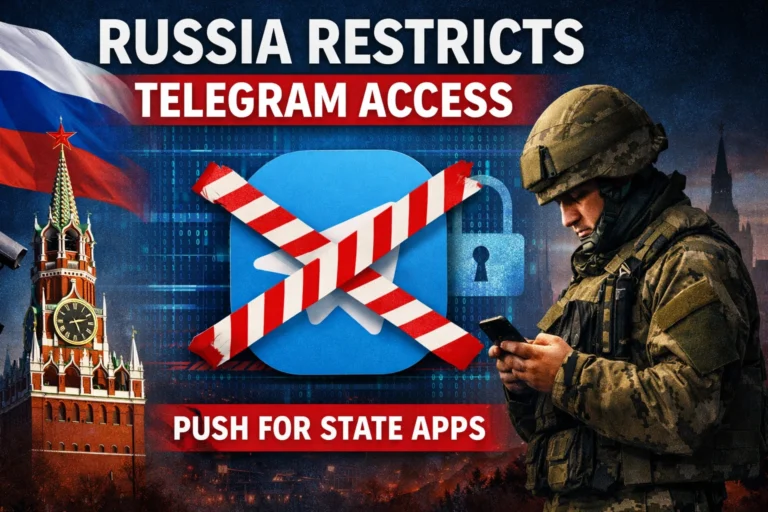

Russia Restricts Telegram: What It Means for Users and Digital Freedom
Russia has begun restricting access to Telegram, one of the country’s most widely used messaging platforms, marking another chapter in the government’s ongoing effort to tighten control over the digital ecosystem. The move signals a broader strategy to steer citizens toward state-supervised alternatives and limit reliance on foreign technology platforms.
This development has sparked debate within Russia and internationally, raising questions about online privacy, censorship, and the future of independent communication platforms in the country.
Government’s Justification for Restricting Telegram
The restriction was announced by Russia’s telecommunications watchdog, Roskomnadzor. Authorities claim the decision is intended to protect Russian citizens. According to officials, Telegram has failed to remove content deemed “criminal” or “terrorist” under Russian law.
In its official statement, Roskomnadzor asserted that Telegram does not adequately safeguard personal data and lacks effective mechanisms to prevent fraud and extremist use of its messaging services. The regulator indicated that restrictions would remain in place until Telegram complies with domestic legal requirements.
Russian state media outlet TASS reported that Telegram is facing fines amounting to 64 million rubles (approximately $828,000). The fines are tied to allegations that the platform refused to delete prohibited content and failed to properly self-regulate.
Telegram, however, has rejected these accusations, maintaining that it actively moderates harmful content and combats misuse of its services.
Widespread Disruptions Reported by Users
Following the enforcement of restrictions, many users across Russia experienced disruptions. Complaints included slow loading times, failed message deliveries, and difficulty accessing the app altogether.
Digital monitoring service Downdetector recorded more than 11,000 complaints within a 24-hour period, highlighting the immediate impact of the government’s measures.
Telegram’s reach in Russia is extensive. The platform is used not only by private citizens but also by state institutions, media outlets, military personnel, and even government agencies — including the Kremlin and Roskomnadzor itself. This widespread adoption makes Telegram an unusual and high-profile target for restrictions.
Pavel Durov Responds
Telegram’s founder, Pavel Durov, responded strongly to the move. The Russian-born entrepreneur characterized the restriction as an attempt to force citizens toward state-controlled alternatives.
Durov emphasized Telegram’s commitment to free speech and privacy, asserting that similar attempts by other governments have failed in the past. He referenced Iran’s earlier effort to ban Telegram in order to promote a domestic alternative, arguing that such strategies rarely succeed when users value independent communication platforms.
Durov’s criticism reflects long-standing tensions between Telegram and Russian authorities. He previously left Russia after refusing to comply with government demands related to user data from his earlier venture.
The Rise of Max: Russia’s State-Backed Alternative
At the center of Russia’s strategy is Max, a government-endorsed messaging app. Authorities now require the app to be pre-installed on all newly sold smartphones and tablets in the country.
Max offers features similar to Telegram, including messaging, voice and video calls, and even money transfers. The app was developed by VKontakte (VK), a social media platform originally co-founded by Durov. VK is now state-owned, a detail that underscores the government’s influence over the alternative ecosystem it is promoting.
The mandatory pre-installation policy signals a deliberate shift toward digital sovereignty — a model in which the state exercises greater control over domestic internet infrastructure and services.
Read also:Acer, ASUS Halt PC Sales in Germany After Nokia Patent Win
A Pattern of Tightening Internet Controls
This is not the first confrontation between Russia and Telegram. In 2018, authorities attempted to block the platform after Telegram refused to provide encryption keys to security agencies. That effort faced technical challenges and widespread public backlash, ultimately proving ineffective.
More recently, Roskomnadzor announced partial restrictions on call features within Telegram and other messaging apps such as WhatsApp. Authorities argued that these services were being exploited for fraud, extortion, and extremist activities.
The renewed crackdown appears to be part of a broader initiative to reduce dependence on foreign digital platforms and strengthen internal monitoring capabilities.
Internal Criticism and Military Concerns
Interestingly, the move has not been universally supported within Russia. Some prominent military bloggers — many of whom report directly from the front lines of the conflict in Ukraine — have criticized the restrictions.
Telegram has become a primary communication channel for military reporting and real-time updates. Critics argue that limiting access could hamper operational communication and information flow.
One influential military commentator suggested that restricting Telegram could undermine Russian forces by disrupting established communication networks. Such reactions illustrate the tension between security objectives and practical realities.
Comparing Russia’s Strategy to China’s Model
Analysts have noted that Russia has increasingly studied China’s digital governance system, commonly referred to as the “Great Firewall.” This sophisticated infrastructure allows Chinese authorities to monitor and control internet traffic within the country.
According to Adam Segal, director of the Digital and Cyberspace Policy program at the Council on Foreign Relations, Russia has made efforts to acquire similar technologies. However, experts suggest that Russia’s technological capabilities and enforcement mechanisms are not yet as advanced as China’s.
Russia faces both technical limitations and domestic resistance. While enforcement tools may improve over time, the country lacks the same degree of centralized internet infrastructure that enables China’s comprehensive filtering system.
The Role of VPNs and Digital Workarounds
Despite government restrictions, technologically adept users are likely to bypass blocks through virtual private networks (VPNs) and other circumvention tools. VPN usage has historically surged in Russia whenever restrictions are introduced.
This dynamic creates a cat-and-mouse scenario: authorities impose controls, and users develop methods to evade them. Such cycles can make complete enforcement difficult.
Experts believe Russia’s approach may unfold incrementally — advancing in certain areas while encountering setbacks in others. The long-term effectiveness of the Telegram restriction remains uncertain.
Broader Implications for Digital Freedom
The Telegram restrictions highlight broader themes shaping Russia’s digital landscape:
- Data Sovereignty: Increased emphasis on domestic platforms and infrastructure.
- Surveillance Concerns: Expansion of tools for monitoring online activity.
- Platform Accountability: Stricter enforcement of content regulations.
- User Resistance: Continued reliance on global platforms and circumvention tools.
For millions of Russian users, Telegram has become more than a messaging app. It serves as a news source, business tool, and community platform. Curtailing access disrupts not only communication but also the broader digital economy and information ecosystem.
What Happens Next?
The future of Telegram in Russia will likely depend on negotiations, technical developments, and political priorities. If Telegram refuses to alter its moderation policies to align with Russian law, restrictions could intensify. Conversely, sustained public backlash or operational challenges may prompt adjustments.
For now, the situation reflects a deeper transformation underway in Russia’s internet governance strategy — one that seeks greater state oversight and reduced reliance on global platforms.
Whether these efforts will succeed in reshaping user behavior remains to be seen. History suggests that digital ecosystems are resilient, and users often find ways to preserve access to the platforms they value most.
As Russia navigates this evolving digital terrain, Telegram’s fate will serve as a significant indicator of how far the country is willing — and able — to go in redefining online freedom within its borders.



Pingback: Acer, ASUS Halt PC Sales in Germany After Nokia Patent Win - All Trends Today
Pingback: Shreyanka Stars as India Take Series Lead - All Trends Today India shreyanka stars a