

India Gate as AQI Crisis: When Delhi’s Landmark Became a Symbol of Desperation
On November 9, 2025, Delhi’s iconic India Gate didn’t just stand as a monument to history—it became the stage for an urgent call to action. Hundreds of residents, parents, children and activists gathered amid alarmingly high pollution readings. The capital’s Air Quality Index (AQI) surged beyond 390 in many zones, with hotspots crossing 400, prompting urgent demands and heavy policing.
What Happened at India Gate as AQI Spiked
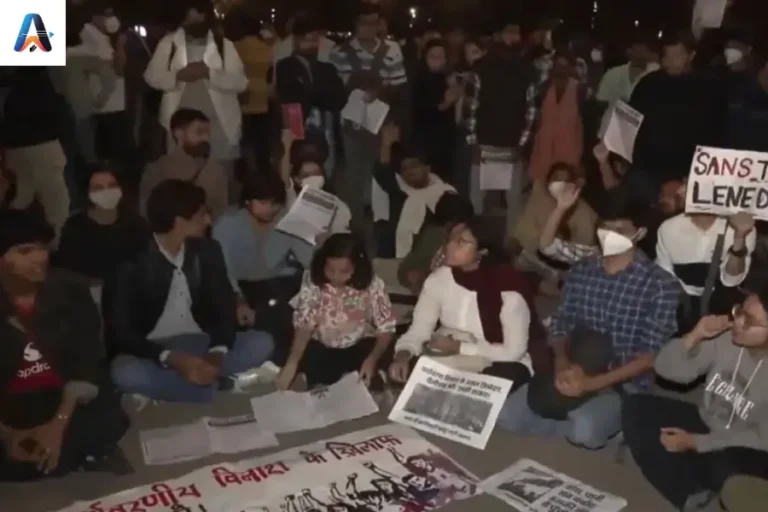
The protest was orchestrated by the campaign Swachh Hawa Abhiyan and attended by families from across Delhi. They held placards reading “Right to live, not just survive” and “Help us breathe”, giving face to the hidden health toll of toxic air.
Sources show AQI readings at or above 295 across New Delhi and deep into “Severe” categories.
Despite being peaceful, the protest saw between 60 and 100 individuals—including parents, elderly residents and even children—detained by Delhi Police for gathering at a non-designated protest site. Many were taken in police buses to verification points before release.
Why India Gate as AQI Is a Powerful Image
- Symbolic location: India Gate is not only a national landmark but a popular open-space in Delhi. Choosing it emphasises how air pollution penetrates even “prestige” zones.
- Visible smog backdrop: Photographs from that day showed smog layered over the monument, turning grandeur into a grey shadow.
- Children & families visible: The presence of parents with kids (some carrying nebulisers) turned abstract pollution stats into human stories.
Read also: Why Rockstar Games Postponed GTA VI Launch Until Late 2026
Root Causes – And How They Played Out
Stubble burning, cold trapping, vehicular & industrial emissions
Each winter, Delhi’s pollution cocktail intensifies: smoke from crop-residue fires in Punjab and Haryana drifts into the capital; low wind speeds trap the pollutants; vehicles and un-regulated industries add to the load.
Urban dust + construction
Dust stirred by construction and road traffic adds coarse particles (PM10) that aggravate the health impact—especially for the elderly and children.
Policy gap
Despite recommendations under the Graded Response Action Plan (GRAP), Delhi often delays moving to higher stages of response when AQI crosses hazardous thresholds. For instance, on the same day Delhi’s AQI soared, GRAP Stage III wasn’t yet triggered.
Health toll real & immediate
An AQI above 300 is labelled “Severe”; above 400 is “Hazardous”. For context: reports place AQI readings of 442 post-Diwali in 2025. Reuters At these levels, breathing is comparable to smoking many cigarettes a day. AQI
Amazing Facts You Need to Know
- Delhi has recorded zero “Good” air-quality days (AQI 0-50) for over two years. Experts call it the longest stretch globally in a major city.
- At India Gate on certain days, real-time data shows PM2.5 reaching ~162 µg/m³ and PM10 ~275 µg/m³—well above safe limits.
- Smog in Delhi has been measured as worse than historical peaks in Beijing—on some days AQI climbed to 1,700.
- A direct human-impact measure: Parts of Delhi’s monitoring network equated current pollution to smoking ~11.5 cigarettes a day.
Voices from the Ground: What Protesters at India Gate Were Saying
Mothers with nebulisers, children in masks, seniors struggling for breath—these weren’t just statistics. One proud parent held a placard: “Breathing is killing me.” Others demanded: “Clean air for children.”
Activists observed a recurring theme: “This is not politics—this is survival.” One veteran organiser said the detentions were a “disguised silencing of distress.”
These voices remind us: when India Gate stood as backdrop, they weren’t just fighting pollution—they were fighting invisibility.
Political Fallout & Governance Implications
Opposition leaders sharply criticised the detentions and demanded transparent, accountable action rather than police enforcement of protest. They emphasise that clean air is a fundamental right under India’s Constitution.
The event places pressure on city and national governments to enact science-based interventions:
- Immediate implementation of Stage III/IV GRAP once AQI enters “Severe”.
- Real-time public filtering of station data, health advisories in schools and workplaces.
- Cross-border coordination with Haryana & Punjab to manage stubble-burning and transport dust.
What Comes Next: From Protest to Policy
1. Public awareness ramps up
The image of families at India Gate against a grey sky triggers a public reckoning. Expect local communities to demand neighbourhood air-monitors, indoor-air alerts and child-safe zones.
2. Technology & innovation
Personal air-quality monitors, apps delivering PM2.5 alerts and respirators may see growth. Artificial-intelligence-based forecasting models will gain traction.
3. Legal pressure
Given Delhi’s chronic air-quality failings, there may be new PILs and citizen-led lawsuits demanding quantified reductions and accountability.
4. Long-term shift
The protest raises hopes for structural changes beyond short-term reaction—industrial emission caps, commuting shifts, urban-vegetation investment, and dust-control measures.
FAQs
A: On Nov 9, 2025, Delhi’s AQI surged past ~390 (some zones over 400). Families, worried about the health impact, assembled at India Gate demanding action.
A: As a national symbol and public open space, India Gate makes the invisible visible—the fact that even landmark zones can’t escape toxic air.
A: A mix of crop-residue burning in neighbouring states, emissions from vehicles & industries, urban dust and meteorological trapping.
A: Delhi follows the GRAP (Graded Response Action Plan) framework, but enforcement in “Severe/Hazardous” phases has been inconsistent.
A: Use N95/KN95 masks outdoors during high AQI, install indoor air purifiers, avoid strenuous outdoor activity when AQI is above 300 and follow real-time local station updates.



Pingback: Family Man Season 3 Release Date, Cast, and Latest Updates - All Trends Today