
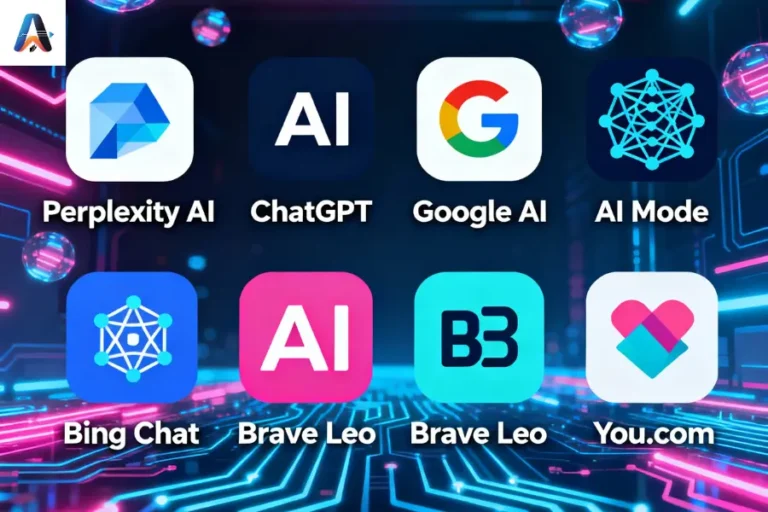

Discover the Most Powerful AI Search Engines for Accurate Results in 2026
As we step into 2026, the digital world is evolving faster than ever, and AI-powered search engines are leading this transformation. No longer limited to displaying endless lists of links, the most powerful AI search engines now understand context, generate human-like responses, and provide precise, real-time answers from trusted sources.
From researchers and marketers to everyday internet users, people everywhere are embracing these intelligent tools for faster, smarter, and more interactive search experiences. If you’re ready to level up how you find information, this guide explores the most powerful AI search engines of 2026, highlighting their key features, advantages, and ideal use cases.
1. Perplexity AI – The Researcher’s Best Companion
Among the most powerful AI tools of 2026, Perplexity AI stands out for its precision and transparency. It delivers concise answers with citations from credible sources like Wikipedia, Forbes, and academic journals — ensuring you never have to second-guess the accuracy of your information.
The platform’s conversational interface allows users to ask follow-up questions naturally, perfect for deep research or project-based work. Whether you’re a student, journalist, or analyst, Perplexity AI helps you find verified information faster than ever.
Top Highlights:
- Provides real-time, sourced answers.
- Combines accuracy with natural language interaction.
- Offers both free and premium versions.
- Ideal for professional and academic use.
In 2026, Perplexity AI remains one of the most powerful AI search engines for users who prioritize reliability and depth.
2. ChatGPT – The Conversational Intelligence Powerhouse
OpenAI’s ChatGPT continues to dominate the AI world in 2026, evolving far beyond a chatbot into a smart conversational search assistant. Powered by the latest GPT-5 model, it understands complex questions and provides detailed, human-like responses supported by up-to-date web data.
ChatGPT integrates directly with tools like Canva, Zapier, and Google Workspace, making it an all-in-one productivity assistant. Whether you’re drafting emails, researching a topic, or generating creative ideas, it delivers insightful answers in seconds.
Key Advantages:
- Conversational, contextual, and accurate responses.
- Access to real-time web browsing and data.
- Supports text, image, and voice inputs.
- Perfect for content creators, marketers, and entrepreneurs.
If you’re looking for the most powerful AI platform that blends creativity with intelligence, ChatGPT remains unmatched in 2026.
3. Google AI Mode – Revolutionizing Smart Search
In 2026, Google AI Mode continues redefining how users interact with search results. By merging Google’s unmatched database with generative AI, it creates rich, summarized answers tailored to your query — complete with visuals, maps, and contextual recommendations.
Searches like “best honeymoon destinations in 2026” now yield AI-generated summaries with travel suggestions, videos, and flight options — all within the results page. It’s fast, intuitive, and seamlessly integrated into Google’s ecosystem.
Why It’s Among the Most Powerful AI Tools:
- AI-powered overviews for complex queries.
- Integrates Google Maps, YouTube, and Scholar.
- Personalized results based on user intent.
- Ideal for everyday and professional users alike.
Google AI Mode continues to be one of the most powerful AI search engines of 2026, delivering clarity, convenience, and insight in one click.
Read also: Make Beautiful Images with ChatGPT AI in Minutes
4. Bing Chat – Smarter, Visual, and Engaging
Microsoft’s Bing Chat—fueled by GPT-4 Turbo—remains a top contender in the race for the most powerful AI search engine title. Its strength lies in its visual and contextual search capabilities, providing results with images, videos, and cited references.
Integrated within Microsoft Edge, Bing Chat works seamlessly with Word, Excel, and Outlook, transforming everyday tasks like report creation or data analysis into quick, AI-assisted workflows.
Highlights:
- AI-generated search results with visuals and citations.
- Integrates with Microsoft 365 and Edge browser.
- Handles voice, text, and image-based queries.
- Excellent for professionals and visual learners.
In 2026, Bing Chat continues to redefine productivity by combining AI intelligence with real-world usability.
5. Brave Search with Leo – The Privacy-First Powerhouse
For users who value privacy above all, Brave Search with Leo is the go-to choice among the most powerful AI search tools. Unlike mainstream search engines, Brave operates on its own independent index, ensuring no data tracking or profiling.
Its built-in AI assistant, Leo, generates ad-free, personalized responses and summaries, making it ideal for privacy-conscious researchers and journalists.
Why Brave Search Shines in 2026:
- 100% privacy protection—no tracking, no ads.
- Fast and independent search results.
- Simple, distraction-free interface.
- Perfect for users who want control over their data.
In a world where privacy is increasingly scarce, Brave with Leo proves that powerful AI doesn’t have to compromise security.
6. You.com – The Customizable AI Search Experience
Among the most innovative AI search engines of 2026, You.com offers a unique advantage — full customization. Users can switch between different AI models (like GPT or Claude) and choose from various “modes” such as writing, coding, or academic search.
The platform’s modular design separates results into sections — articles, videos, social media, and products — making multitasking effortless. It’s an ideal choice for developers, students, and content creators who want flexibility and control.
Key Features:
- Switch between multiple AI models.
- Personalized dashboards for different tasks.
- Integrates with productivity apps and plugins.
- Great for deep research and creative workflows.
You.com represents the next evolution of personalized search, earning its spot among the most powerful AI tools of 2026.
The Future of AI Search: What to Expect Beyond 2026
The most powerful AI search engines of 2026 are not just about finding answers—they’re about understanding human intent. As AI continues to evolve, future search engines will become more context-aware, voice-interactive, and even emotionally intelligent, adapting to individual user preferences.
In the coming years, we can expect these AI tools to integrate seamlessly with daily life — planning trips, managing finances, writing reports, and even predicting needs before you ask. The age of smart, intuitive, and secure search has truly begun.
FAQs
As of 2026, Perplexity AI and ChatGPT (with real-time browsing) are among the most powerful AI search engines. They deliver context-rich answers, verify sources, and support conversational follow-ups for deeper insights.
Unlike traditional search engines that only display links, AI-powered search engines analyze your question, understand context, and generate complete, human-like answers — often with source citations and real-time data.
While ChatGPT started as a conversational AI, its newer versions integrate real-time web access, making it function like a hybrid search assistant and knowledge generator. It’s ideal for users who want detailed explanations instead of link lists.
If privacy is your top concern, Brave Search with Leo is your best option. It uses an independent search index, doesn’t track user activity, and provides AI-enhanced summaries without compromising user anonymity.
Absolutely. Perplexity AI and You.com are especially suited for academic research, journalism, and business analysis due to their citation-rich responses and real-time accuracy. They also allow users to cross-check sources instantly.



Pingback: Why Rockstar Games Postponed GTA VI Launch Until Late 2026 - All Trends Today
Pingback: Van Meekeren Laments Missed Chance as Netherlands Fall Short Against Pakistan in T20 World Cup Ope - All Trends Today