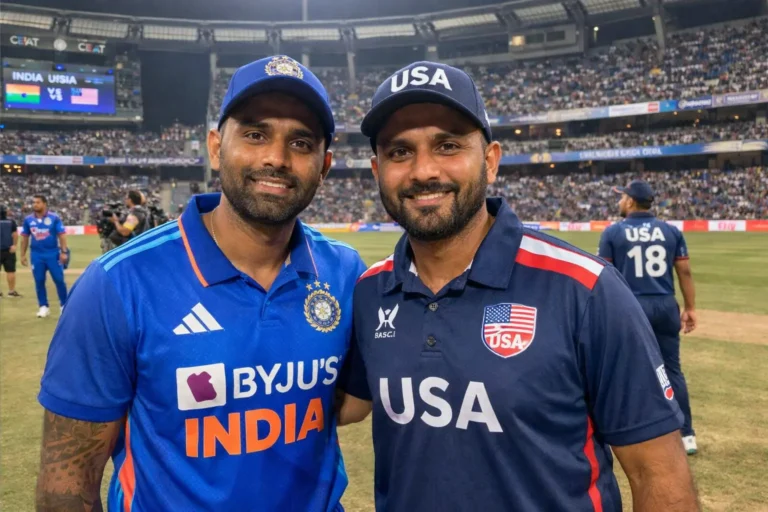

The opening match between India and United States of America delivered intrigue even before a ball was bowled. At the iconic Wankhede Stadium, USA captain Monank Patel won the toss and made the bold decision to bowl first against one of the most destructive batting line-ups in world T20 cricket. With Jasprit Bumrah ruled out due to illness, India handed a recall to Mohammed Siraj, setting the tone for a match shaped by both opportunity and uncertainty.
A fearless toss call against a powerhouse
Choosing to bowl first against India at Wankhede raised eyebrows instantly. The ground is widely regarded as a batting paradise, especially under lights, where short boundaries and a true surface often turn good totals into great ones. Yet Monank Patel’s decision reflected USA’s intent to challenge themselves against elite opposition rather than play conservatively.
India, meanwhile, were unlikely to shy away from batting regardless of the toss. Captain Suryakumar Yadav confirmed as much, indicating that setting a commanding total was always part of the plan. Given India’s recent record—multiple scores above 250 in this T20 cycle—the prospect of another massive total quickly became a talking point.
India’s recent batting form fuels 300-run chatter
Speculation around a 300-run innings may sound extreme, but India’s numbers justify the excitement. Since the last World Cup, they have crossed 250 on three occasions, and overall no team has posted more 250-plus totals during this cycle. Against a comparatively inexperienced USA bowling attack, and on a surface like Wankhede, expectations soared.
The Indian top order features a blend of explosive starts and middle-overs acceleration. Abhishek Sharma’s fearless approach at the top, followed by the left-hand dynamism of Ishan Kishan, provides immediate pressure. With Tilak Varma and Suryakumar Yadav anchoring and attacking in equal measure, India possess the depth to sustain aggression for all 20 overs.
Fitness setbacks test India’s depth
While batting optimism dominated discussions, India entered the match managing notable fitness concerns. Fast bowler Harshit Rana was already sidelined after sustaining an injury in a warm-up fixture, and the absence of Jasprit Bumrah due to illness further tested India’s pace resources in the tournament opener.
Siraj’s inclusion was therefore significant. Having last played a T20I in July 2024, he returned with a point to prove. Known more for his red-ball consistency and ODI rhythm, Siraj’s ability to adapt quickly to T20 demands became a subplot worth watching. Alongside Arshdeep Singh, he carried responsibility in the powerplay and death overs.
India otherwise stuck to expected selections. Kishan was preferred over Sanju Samson behind the stumps, reinforcing a left-right balance at the top. In the spin department, India opted for just one “mystery spinner” in Varun Chakravarthy, leaving out Kuldeep Yadav and backing finger spin and all-round options through Axar Patel.
Read also: Tilak Varma: Age, Height, Wife, Net Worth, Injury Updates, Stats & IPL 2026 Cast
USA’s India connection adds emotional edge
For the USA squad, this match carried special meaning. Many players have roots in Indian cricketing culture, and several began their journeys in Mumbai itself. Harmeet Singh, Saurabh Netravalkar, and Shubham Ranjane all started their cricketing paths in the city, making a Wankhede appearance particularly symbolic.
This was also USA’s first match on Indian soil, adding layers of excitement and pressure. Familiar surroundings, combined with unfamiliar opposition quality, created a unique challenge. The inclusion of big-hitting wicketkeeper-batter Andries Gous strengthened their batting, especially after he missed their previous T20I appearance in last year’s North America T20 Cup final.
Tactical battles to watch
From a tactical standpoint, the match presented several key battles:
- Powerplay control: USA’s new-ball bowlers needed early breakthroughs to curb India’s run rate. Any looseness in line or length could be punished severely.
- Middle-overs spin: Varun Chakravarthy’s variations versus USA’s middle order could dictate momentum. For the USA, negotiating spin without losing wickets was crucial.
- Death overs execution: With finishers like Hardik Pandya and Rinku Singh waiting, USA’s death bowling discipline would be tested relentlessly.
Conversely, India’s bowling focus centered on adaptability. Without Bumrah’s yorkers and composure at the death, collective execution and smart field placements became essential.
Confirmed playing XIs
India: Abhishek Sharma, Ishan Kishan (wk), Tilak Varma, Suryakumar Yadav (capt.), Hardik Pandya, Rinku Singh, Shivam Dube, Axar Patel, Arshdeep Singh, Mohammed Siraj, Varun Chakravarthy
USA: Saiteja Mukkamalla, Andries Gous (wk), Monank Patel (capt.), Milind Kumar, Sanjay Krishnamurthi, Harmeet Singh, Shubham Ranjane, Mohammad Mohsin, Shadley van Schalkwyk, Saurabh Netravalkar, Ali Khan
More than just an opener
Beyond runs and wickets, this match symbolized cricket’s expanding global footprint. For India, it was about asserting dominance early despite missing key personnel. For the USA, it represented an opportunity to measure themselves against the very best, on one of cricket’s grandest stages.
Whether the game lived up to the pre-match talk of record-breaking totals or turned into a test of resilience, the toss decision and team selections ensured one thing: the spotlight was firmly on Wankhede, where ambition, history, and global cricketing dreams converged.